
From Friday, January 16th to Monday, January 19th, seven birders joined TAS Field Trip Coordinator Brian Rapoza for Tropical Audubon’s annual winter birding tour to the Tallahassee area in north Florida. The group consisted of John Boyd, Nancy Freedman, Liz Gushee, Deb Magid, Ann Martinez and Jim Sigsbee, all from Miami-Dade County, and Ann Wiley from Broward County.
We experienced weather that was almost identical to what we dealt with during last year’s tour: passage of a cold front that produced rain on Saturday and Sunday, followed by below-freezing temperatures on Monday. Fortunately, the rain on Saturday held off until late in the day, allowing us to stick to our planned itinerary. Our luck didn’t last, though, as it was still raining on Sunday morning. The inclement weather was forecast to last until midday, forcing us to completely alter that day’s itinerary.
Friday, January 16
Our first stop on this year’s itinerary didn’t come until we arrived in the Gainesville area. Birds seen on our way there included Wood Stork, Sandhill Crane and Crested Caracara. Once in Gainesville, we made a quick stop at a retention pond where a pair of Common Goldeneye were wintering. Presumably, it was the same pair we saw when we visited this retention pond at the end of last year’s tour. A pair of Hooded Mergansers as well as White Ibis and Great Egret were also present. Next, we visited a neighborhood where a vagrant Calliope Hummingbird had been seen for the past couple of weeks, but unfortunately, the bird wasn’t present on the property we checked (it was seen on a property nearby a few days later). While we were there, we tallied thirteen species: Turkey Vulture, Downy Woodpecker, Northern Flicker, White-eyed Vireo, Blue Jay, Carolina Chickadee, Tufted Titmouse, Ruby-crowned Kinglet, Carolina Wren and Black-and-white, Magnolia, Yellow-rumped and Yellow-throated Warblers.
Before continuing our drive to Tallahassee, we spent some time exploring nearby Sweetwater Wetlands, where we found thirty-five species, including Common Gallinule, American Coot, Spotted Sandpiper, Pied-billed Grebe, Wood Stork, Anhinga, Double-crested Cormorant, Glossy Ibis, Roseate Spoonbill, American Bittern, Black-crowned Night Heron, Great Blue, Little Blue, Tricolored and Green Herons, Snowy Egret, Northern Harrier, Red-shouldered Hawk, Belted Kingfisher, Red-bellied Woodpecker, Eastern Phoebe, Tree Swallow, Northern House Wren, Chipping and Swamp Sparrows, Red-winged Blackbird, Common Yellowthroat, Palm Warbler and Northern Cardinal. After arriving in Tallahassee and checking into our hotel, we had dinner at a nearby Red Lobster.
Saturday, January 17
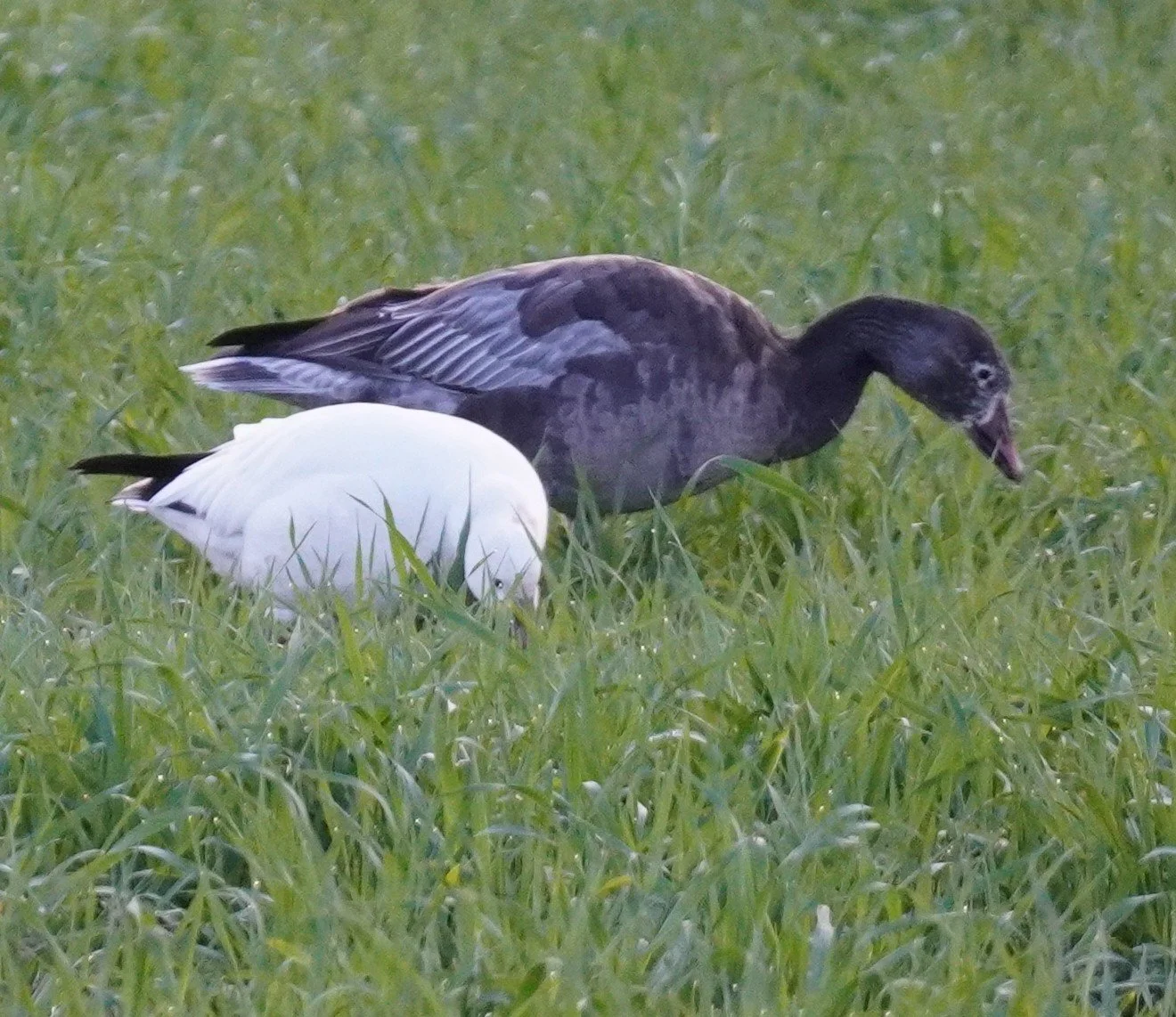
We encountered our first Canada Geese in the parking lot of a Publix where we stopped to buy lunch supplies. Canada Geese were also present at our first birding stop, in a subdivision on the east side of Tallahassee. Among them were two other geese: a blue-morph Snow Goose and a Ross’s Goose! Other birds among the fourteen species we found there were Mourning Dove, Killdeer, American Crow, Northern Mockingbird, Eastern Bluebird and Chipping Sparrow.
The rest of the morning and part of the afternoon was spent at St. Marks National Wildlife Refuge, south of Tallahassee in Wakulla County. Our first stop was at the Plum Orchard Trail, located at the refuge’s visitor center. Twenty-two birds were tallied during this stop, including Yellow-bellied Sapsucker, Brown-headed Nuthatch, Gray Catbird, Hermit Thrush, American Robin and American Goldfinch. The only Golden-crowned Kinglet for the trip was seen near the visitor center by Ann Wiley and was later heard by John Boyd. Our next stop was at the trail leading to the refuge’s helipad, where we found seventeen species, including Eastern Towhee.
Subsequent stops were at roadside pools and ponds that provide habitat for a variety of waterfowl, wading birds, shorebirds and birds of prey. At East River Pool, we saw twenty-five species, including Gadwall, Green-winged Teal, Lesser Scaup, Black-necked Stilt, Black-bellied Plover, Long-billed Dowitcher, Lesser Yellowlegs, Dunlin, Least and Western Sandpiper, Ring-billed Gull, Forster’s Tern and Bald Eagle. At Headquarters Pond, we added Blue-winged Teal, Ring-necked Duck, Bufflehead, Sora, and Osprey. At adjacent Picnic Pond, where we had lunch, we found American Wigeon, Redhead and American White Pelican.
Our last stop within the refuge was at Lighthouse Pool, where we found hundreds of shorebirds, including Black-bellied and Semipalmated Plovers, Marbled Godwit, Short-billed Dowitcher, Willet, Ruddy Turnstone, Dunlin, and Least and Western Sandpipers. Other birds seen at this pool included Hooded and Red-breasted Mergansers, Laughing and American Herring Gulls, Black Skimmer, Forster’s and Royal Terns and American White and Brown Pelicans. Two perched Bald Eagles were seen as we approached the pool. We also scanned offshore from the lighthouse, finding Horned Grebe and Common Loon, along with flocks of Lesser Scaup and Bufflehead. A Song Sparrow was spotted along the shoreline.
Leaving the refuge, we drove west to Alligator Point, in Franklin County, where we found twenty-four species, including a flock of Black Scoter and a couple of Boneparte’s Gulls. We ended the day at Bottom’s Road, in another section of St. Marks refuge, where we found Clapper and Virginia Rail, Sedge Wren and Nelson’s Sparrow. Another Common Loon and a few Bufflehead and Ring-billed Gulls were seen from the boat landing at the end of the road. Dinner was at Posey’s, a seafood restaurant in the town of Panacea.
Sunday, January 18
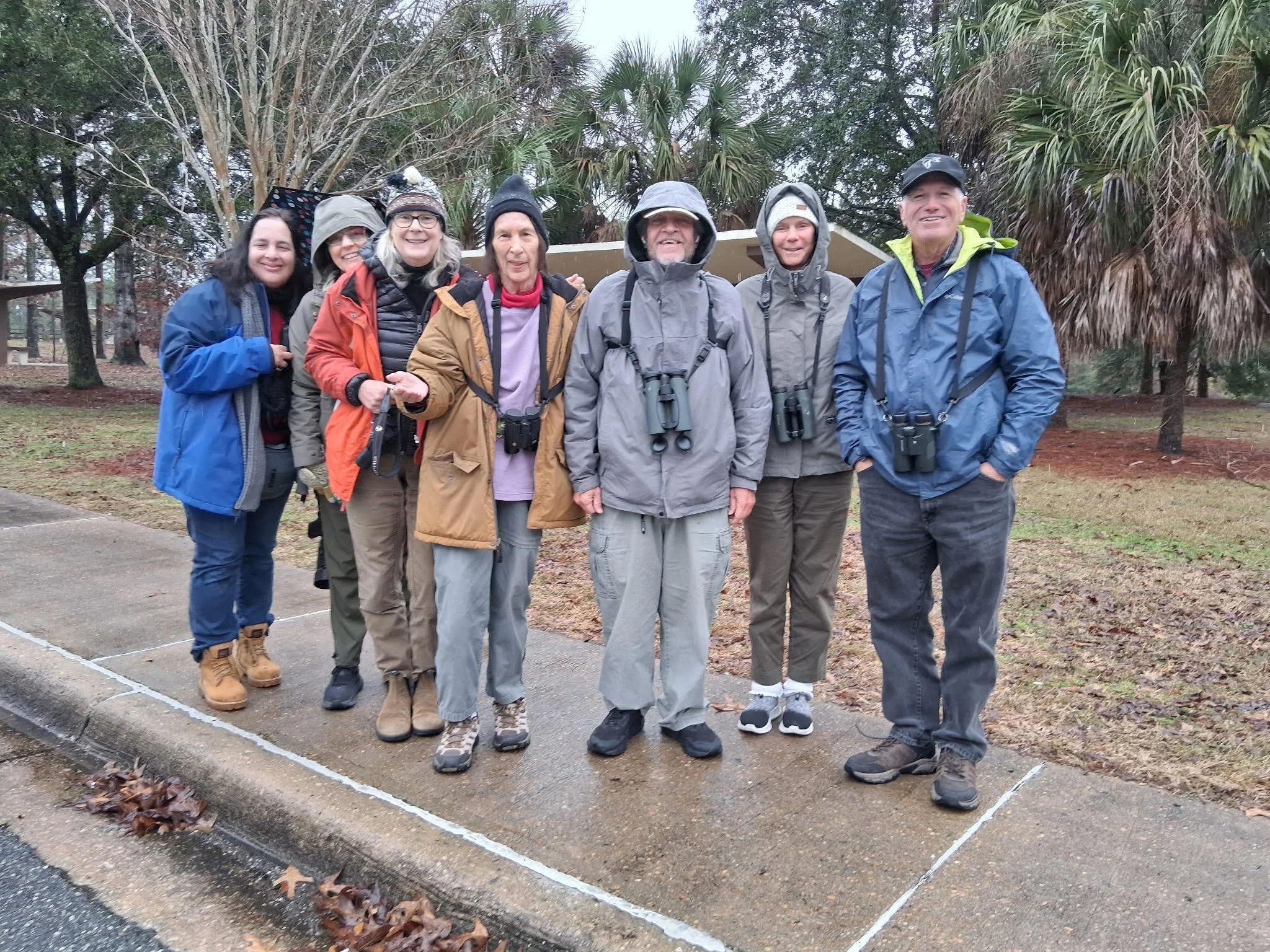
Photo courtesy of Nancy Freedman
It was raining lightly when we met for breakfast, but the rain increased in intensity as we were driving to our planned first stop at Tall Timbers Research Station, so we turned around and headed west on I-10, hoping to find better weather beyond the trailing edge of the cold front that was moving east through the area. We stopped for a restroom break at Edger Warren Scarborough Park, an I-10 rest area on the east side of the Apalachicola River, where we encountered snow flurries! We also found eleven bird species while there, including Downy Woodpecker, Ruby-crowned Kinglet, American Robin, Cedar Waxwing, Chipping Sparrow and Pine Warbler.
Crossing the Apalachicola River and entering the Central Time Zone, we continued west to the Marianna area in Jackson County, where we finally encountered blue skies. We headed north to an agricultural area near the border with Alabama, where we found a plowed field with a few Killdeer and Mourning Doves, but farther out, we spotted at least three Horned Larks and a couple of Vesper Sparrows! Other birds seen while in this area included Black Vulture, American Kestrel and Savannah Sparrow.
After lunch at Sonny’s BBQ near Marianna, we visited Florida Caverns State Park. For most of us, this was our first visit since the park was devastated by Hurricane Michael in 2018. The park’s beautiful bottomland forest is just beginning to recover and was mostly unrecognizable to those in our group who remember what it looked like prior to the hurricane. We managed to find sixteen species during our visit, including Red-tailed Hawk and Red-headed Woodpecker. We ended our day in the Lake Seminole area on the Florida-Georgia border. We were hoping to see waterfowl that often congregate on the lake during winter, but during a quick visit to Sneads Park, we found only a Common Loon. At Three Rivers State Park, we saw a Bald Eagle and seven other species, but no ducks or other waterfowl. Back in Tallahassee, we had dinner at San Miguel’s, a Mexican restaurant located south of our hotel.
Monday, January 19
After checking out of our hotel, we paid a visit to the home of Kathleen Coates, who lives in the Heartwood Hills subdivision east of Tallahassee. Our targets were the Black-chinned Hummingbird and Purple Finches that were regularly visiting feeders in her yard. In addition to seeing both the hummingbird and the finches, we tallied twenty other species during our visit, including Red-headed and Pileated Woodpecker, Cedar Waxwing, House Finch, Baltimore Oriole and a stunning male Summer Tanager. Kathleen also provided us with information about another home in Tallahassee where a Buff-bellied Hummingbird was regularly visiting, so we spent some time there before heading back to Miami. We saw the Buff-bellied Hummingbird almost as soon as we arrived; as a bonus, we added two other new birds while there: a White breasted Nuthatch and a male Painted Bunting!
We ended the tour with 123 species, all are listed in this eBird trip report, which also includes checklists for each of the locations we visited. A few birds, such as Sandhill Crane and Crested Caracara, were only seen while driving, so they are not included in this total.
Ross’s Goose and blue-morph Snow Goose. Photo by Brian Rapoza